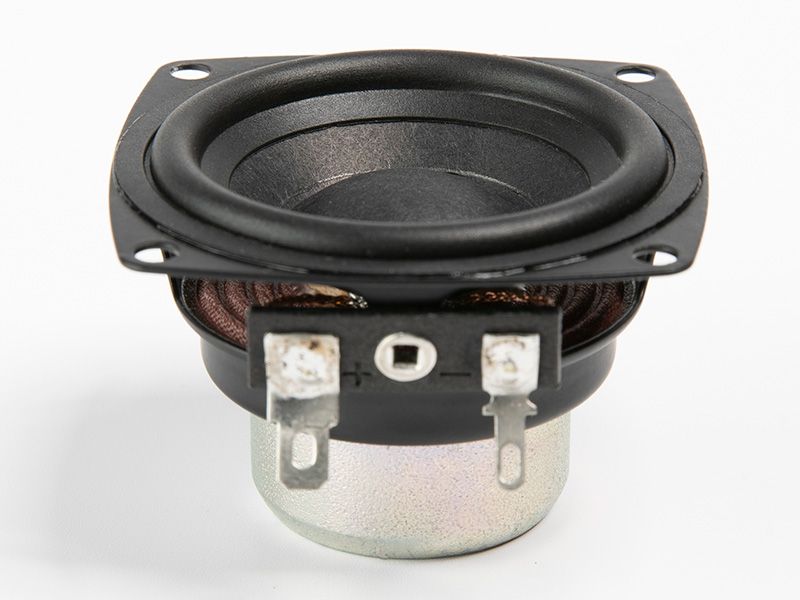
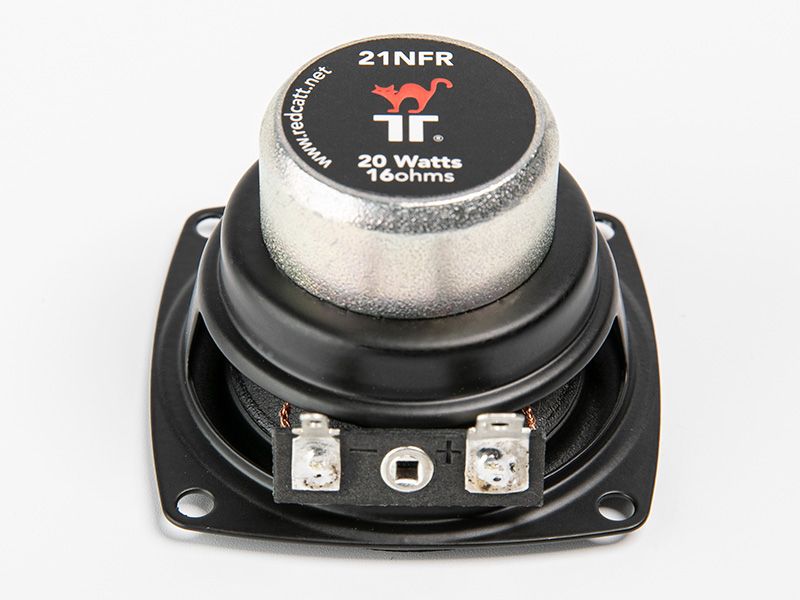
LF
Fullrange
2"
21NFR
Code: 21NFRX16-393D
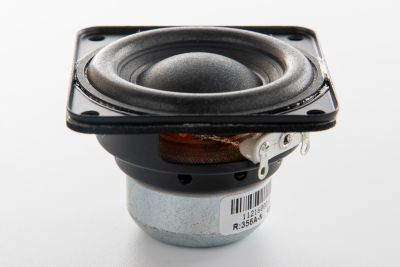
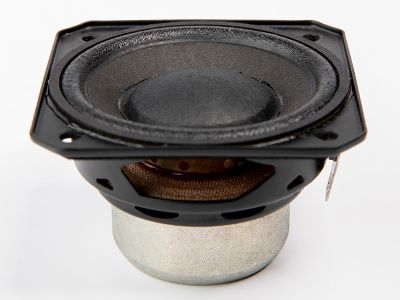
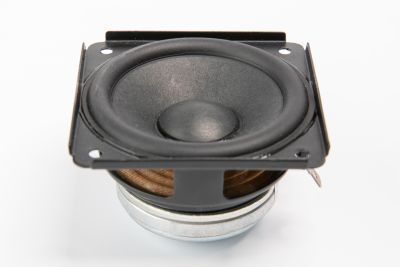
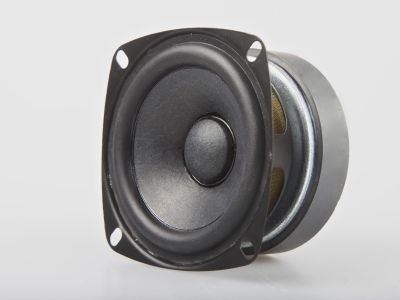
Full-Range/2inch/Neo/Paper/10W/16ohm
Key Features
- Compact, full-range design
- Highly efficient magnetic structure
- High power handling capability
Quick Specs
Impedance
16 Ω
Program Power
20 W
Sensitivity
84.70 dB
Fs
157.00 Hz
Magnet
Neodymium
Voice Coil
20.3 mm
Design Notes
Introducing the 21NFR - a small driver with a mighty punch! This gem was developed to deliver a full range of frequencies, from rich bass to crystal-clear highs, making it the perfect choice for portable products, bookshelf speakers, and array applications in columns.
What sets the 21NFR apart is its full-range behavior, eliminating the need for additional tweeters while still achieving excellent sound quality. Our extensive experience in designing highly efficient transducers shines through in this driver, offering top-notch performance without breaking the bank.
The u-cup style magnetic system is optimized to deliver consistent magnetic flux to the voice coil across the entire operational range, ensuring a powerful and consistent audio experience. Plus, with a lightweight yet robust cone attached to our specially crafted rubber blend surround, the 21NFR is designed to handle low frequencies with ease while also excelling as a high-frequency device.
Get ready to experience the power and versatility of the 21NFR - where small size meets massive performance.
What sets the 21NFR apart is its full-range behavior, eliminating the need for additional tweeters while still achieving excellent sound quality. Our extensive experience in designing highly efficient transducers shines through in this driver, offering top-notch performance without breaking the bank.
The u-cup style magnetic system is optimized to deliver consistent magnetic flux to the voice coil across the entire operational range, ensuring a powerful and consistent audio experience. Plus, with a lightweight yet robust cone attached to our specially crafted rubber blend surround, the 21NFR is designed to handle low frequencies with ease while also excelling as a high-frequency device.
Get ready to experience the power and versatility of the 21NFR - where small size meets massive performance.
Specifications
General Specs
Nominal Diameter
2"
Rated Impedance
16 Ohm
Magnet
Neodymium
Basket Material
Steel
Power Handling
AES Power
10 W
Continuous Power
20 W
Peak Power
40 W
Voice Coil
Diameter
20.3 mm
Winding Wire
CCAW
Former
kapton
Winding Height
6.4 mm
T/S Parameters
Resonant Frequency (Fs)
157.00 Hz
Re
10.20 \u2126
Qes
0.820
Qms
3.80
Qts
0.680
Vas
0.25 liters
Sd
16.62 cm\u00B2
Mms
1.59 grams
Rms
0.41
Cms
0.6500
Bl
4.40 T\u00B7m
Le
0.100 mH
Sensitivity
84.70 dB
Design Details
Surround Material
NBR
Cone/Dome Material
Paper CF
Spider
Nomex
T-Plate
4 mm
Xmax (peak)
1.2 mm
Xmech
5.2 mm
Overall Diameter
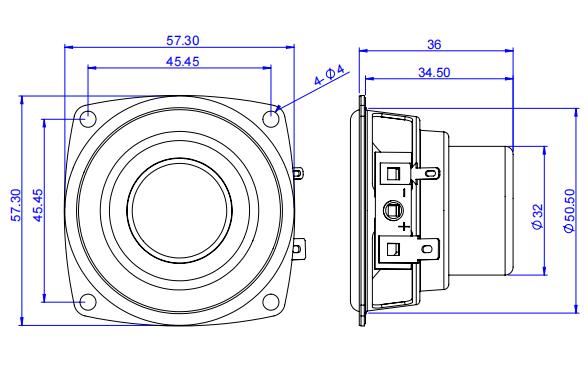
57.30 mm
Bolt Circle Diameter
45.45 mm
Baffle Cutout Dia.
50.50 mm
Mounting Holes
4
Depth (flange to rear)
34.50 mm
Net Weight
0.12 kg
Ordering Codes
Product Code
21NFRX16-393D
Downloads
2D Drawing
Enclosure Recommendations
21NFRX16-393D — Enclosure Design Reference & AI Summary
Generated by REDCATT Speaker Enclosure Tool
=== DRIVER IDENTITY ===
Code: 21NFRX16-393D
Platform: 21NFR
Description: 2-inch Full-Range | Neodymium | Carbon Fiber Paper | 10W AES / 16Ω
Intended Use: TV sets, soundbars, vertical column speaker arrays, small portable speakers,
near-field consumer and commercial audio — 16Ω version for array wiring flexibility
=== THIELE-SMALL PARAMETERS ===
Fs: 157 Hz
Re: 10.2 Ω
Qes: 0.82
Qms: 3.8
Qts: 0.68
Vas: 0.25 L (250 mL)
Sd: 16.62 cm²
Sensitivity: 84.7 dB (2.83V/1m) / 85.76 dB (1W/1m)
Mms: 1.59 g
Rms: 0.41 N·s/m
Cms: 0.65 mm/N
Bl: 4.4 T·m
Le: 0.10 mH
Xmax: 1.2 mm (one-way, peak)
Xmech: 5.2 mm
Xprot: 8.2 mm
Power: 10W AES / 20W continuous / 40W peak / 16Ω nominal
Voice Coil: 20.3mm CCAW on Kapton former
Cone: Carbon fiber reinforced paper
Surround: NBR rubber blend (robust, weather-tolerant)
Spider: Nomex
Basket: Steel
Magnet: Neodymium, U-cup steel circuit
=== DERIVED PARAMETERS ===
Volume displacement (Vd): Sd × Xmax = 16.62 × 0.12 cm = 2.0 cm³
Inductance rolloff onset (f_Le): Re / (2π × Le) = 10.2 / (2π × 0.0001) ≈ 16,242 Hz
Cone radius (r_cone): √(Sd/π) = √(16.62/π) = 2.30 cm
Cone beaming onset (f_beam): c / (π × r_cone) = 34,400 / (π × 2.30) ≈ 4,761 Hz
Max SPL @ 10W AES: 85.76 + 10·log₁₀(10) = 95.8 dB (1m)
Max SPL @ 20W continuous: 85.76 + 10·log₁₀(20) = 98.8 dB (1m)
Zobel network: R_z = 10.2 Ω (series), C_z = Le/Re² = 1.0 μF (series)
NOTE ON SENSITIVITY AND 16Ω IMPEDANCE:
The 16Ω nominal impedance gives 85.76 dB (1W/1m) — approximately 6 dB higher than
the companion 20NFRX4-345A (79.56 dB 1W/1m) at the same rated power. This efficiency
advantage is inherent to the higher-impedance design: at 1W input, more voltage is
applied across the voice coil (V = √(P×Re) ≈ 3.2V) than in a 4Ω driver (≈1.9V),
producing greater BL force per watt. This also means the 21NFR requires an amplifier
capable of swinging higher output voltage, which is typical in column speaker and
installed sound amplifiers.
NOTE ON f_Le:
At 16,242 Hz, the inductance rolloff onset is well beyond the audio band. The driver
maintains a substantially resistive impedance across 20 Hz–16 kHz — a significant
advantage for full-range operation and passive crossover design.
=== ENCLOSURE RECOMMENDATION ===
Qts = 0.68 → Free-air / open-back preferred; sealed micro-enclosures as secondary option.
IMPORTANT — SEALED BOXES DO NOT IMPROVE BASS FOR THIS DRIVER:
Qts = 0.68 is already close to the Butterworth value (0.707), meaning the driver is
nearly critically damped in free air. A sealed enclosure adds air-spring stiffness,
raising system Qtc above 0.68, which shifts the system resonance upward and increases
f-3dB. Any sealed rear cavity worsens the low-frequency extension compared to free-air
operation:
Free air (Qtc = 0.68): f-3dB ≈ 164 Hz ← best bass extension
Qtc = 1.00 (215 mL box): f-3dB ≈ 182 Hz (18 Hz higher — worse)
Qtc = 1.20 (118 mL box): f-3dB ≈ 204 Hz (40 Hz higher — worse)
Butterworth (Qtc = 0.707) would require ≈ 3.1 L — wholly impractical for a 2" driver.
The practical conclusion: for column speaker arrays and open-back TV/soundbar designs,
free-air or open-back installation maximises low-frequency extension. Where a sealed
rear cavity is required for structural reasons (TV chassis, soundbar enclosure), make
it as large as possible, and rely on DSP equalization to correct the response.
--- FREE-AIR / OPEN-BACK (preferred — column arrays, open-baffle TV panels) ---
In free air, the driver operates at its natural Qts = 0.68, with:
System resonance: Fs = 157 Hz
System f-3dB: ≈ 164 Hz
Natural response: flat from ~200 Hz to ~4.5 kHz; gentle rise approaching Fs
DSP equalization in the host system extends usable bass response below 157 Hz as needed.
The 1.2mm Xmax limits the amount of bass boost that can be applied before over-excursion;
low-frequency DSP boost must be engineered conservatively relative to rated power level.
--- SEALED MICRO-ENCLOSURES (secondary — TV / soundbar / portable) ---
These alignments are provided for designs where a closed rear cavity is structurally
required. All volumes are in millilitres (mL). DSP correction is required in all cases.
Alignment 1 — Largest practical sealed cavity (portable speaker)
Cabinet volume (Vb): 215 mL
System Qtc: 1.00
System fc: 231 Hz
System f-3dB: 182 Hz
Notes: Best bass extension achievable in a sealed box; still 18 Hz worse than free air;
a lightly peaked response requires mild DSP correction; suited to portable
products where sealed construction is necessary
Alignment 2 — Compact sealed (soundbar / column rear cavity)
Cabinet volume (Vb): 118 mL
System Qtc: 1.20
System fc: 277 Hz
System f-3dB: 204 Hz
Notes: Compact cavity for soundbar or per-driver rear chamber in column enclosures;
noticeably peaked response; mandatory DSP high-pass and bass correction
Alignment 3 — Minimal sealed (TV set / ultra-slim product)
Cabinet volume (Vb): ≤50 mL
System Qtc: ~1.5+
System fc: ~330 Hz+
System f-3dB: ~230 Hz+
Notes: Very small chassis cavity typical of thin TV sets; strongly peaked response;
full DSP management by host device essential; acceptable given that TV audio
is always processed; maximise available cavity volume within chassis constraints
=== COLUMN SPEAKER / ARRAY GUIDANCE ===
The 16Ω nominal impedance makes the 21NFR particularly suited to column speaker arrays,
where multiple drivers are wired in parallel or series-parallel combinations to achieve
standard 4Ω or 8Ω amplifier loads:
4× 16Ω in parallel = 4Ω
2× 16Ω in parallel = 8Ω
2× 16Ω in series = 32Ω (bridged amp applications)
Array directivity — the 57.3mm overall driver diameter determines minimum pitch in a
vertical column, limiting coherent array directivity:
Maximum coherent array frequency: c / (2 × driver pitch)
= 34,400 cm/s / (2 × 5.73 cm) ≈ 3,002 Hz ≈ 3.0 kHz
Above approximately 3.0 kHz, grating lobes will appear in the vertical radiation pattern.
The 4,761 Hz cone beaming onset provides complementary high-frequency directivity control
above the grating lobe threshold.
For column enclosures, open-back or maximum rear cavity per driver is recommended
(see enclosure discussion above). A per-driver rear cavity of 100–215 mL is preferred
where structurally achievable; accept smaller cavities if chassis depth is constrained
and correct with DSP.
The NBR rubber surround is more durable and weather-tolerant than foam, making the
21NFR better suited to outdoor or semi-outdoor column speaker installations where
the 20NFR's foam surround may degrade over time.
=== CROSSOVER / DSP GUIDANCE ===
Full-range operation: 157 Hz – 16+ kHz (natural; usable from ~200 Hz without EQ)
With DSP / host EQ: Bass extension below 157 Hz — use conservatively given Xmax = 1.2 mm
High-pass filter: Recommended at 80–100 Hz minimum to prevent over-excursion;
Xmax = 1.2mm is very short — aggressive bass boost at low power
levels can exceed mechanical limits
Cone beaming: Onset at ~4,761 Hz; directivity narrows above this frequency;
acceptable for near-field and column speaker applications
Inductance rolloff: Onset at ~16,242 Hz — negligible effect across the entire audio band
Passive crossover: Zobel network (10.2Ω + 1.0 μF in series across driver terminals)
compensates voice coil inductance for passive network designs
XMAX WARNING:
At 1.2mm one-way peak excursion, this driver has very limited mechanical headroom at
bass frequencies. Any DSP bass boost must be implemented with excursion limiting or
brick-wall high-pass filtering above the excursion limit frequency. This is especially
important at higher power levels where thermal rating may still allow operation but
mechanical over-excursion is already occurring below 200 Hz.
=== 20NFR PLATFORM COMPARISON ===
Both drivers share the same application profile (TV, soundbar, column array, portable).
Parameter 20NFRX4-345A 21NFRX16-393D
Impedance 4Ω 16Ω
Fs 185 Hz 157 Hz
Qts 0.52 0.68
Vas 90 mL 250 mL
Sd 11.34 cm² 16.62 cm²
Xmax 3.0 mm 1.2 mm
Vd 3.40 cm³ 2.0 cm³
Sensitivity (1W/1m) 79.56 dB 85.76 dB
Max SPL (10W AES) 89.6 dB 95.8 dB
f-3dB free air 272 Hz 164 Hz
f_beam 5,764 Hz 4,761 Hz
Surround Foam NBR rubber
Cone Paper GF Paper CF
Best enclosure type Small sealed box Free-air / open-back
SELECTION GUIDANCE:
Choose 20NFRX4-345A where: a sealed rear cavity provides useful acoustic loading
(Qts=0.52 means sealed boxes genuinely improve bass extension); higher Xmax (3.0mm)
supports more aggressive bass boost; 4Ω matches standard consumer amplifier loads.
Choose 21NFRX16-393D where: open-back or free-air installation is used; multiple drivers
are wired in parallel for column arrays (16Ω enables flexible load combinations);
NBR surround durability is required for outdoor or harsh environments; higher per-watt
sensitivity (85.76 dB, 6 dB advantage) is the primary selection criterion.
=== SUMMARY ===
The 21NFRX16-393D is a 2-inch full-range driver designed for embedded consumer and professional audio applications requiring a 16Ω impedance — primarily vertical column speaker arrays, flat-panel TV sets, soundbars, and compact portable products. It features a carbon fiber reinforced paper cone driven by a 20.3mm CCAW voice coil on a Kapton former, a neodymium U-cup magnetic circuit, and an NBR rubber surround engineered for durability in outdoor and long-term installations. Sensitivity is 85.76 dB (1W/1m) / 84.7 dB (2.83V/1m), with a Bl of 4.4 T·m, supporting 10W AES / 20W continuous power handling. The 16Ω nominal impedance offers 6 dB higher sensitivity per watt than the 4Ω companion 20NFRX4-345A and enables flexible parallel wiring in column arrays (4× 16Ω in parallel = 4Ω). Qts = 0.68 reflects a compliant suspension design suited to free-air and open-back installations, where the driver's natural motor damping produces the best available low-frequency extension.
Unlike lower-Qts drivers, this driver does not benefit from sealed enclosure loading — any sealed rear cavity raises Qtc above 0.68 and shifts f-3dB upward rather than downward. Free-air or open-back installation is therefore preferred for maximum bass extension, with a natural system f-3dB of approximately 164 Hz:
• Free air / open-back — f-3dB ≈ 164 Hz — preferred for column arrays and open-back designs
• 215 mL sealed (Qtc=1.00, f-3dB 182 Hz) — largest practical sealed alignment for portable use
• 118 mL sealed (Qtc=1.20, f-3dB 204 Hz) — compact rear cavity for soundbar or column enclosures
• ≤50 mL sealed (Qtc≥1.5, f-3dB ≥230 Hz) — TV chassis or ultra-slim products; full DSP correction required
Amplification of 10–20W from a 16Ω-rated output is appropriate, delivering a peak SPL of 95.8 dB at 1 metre (10W AES). The 1.2mm Xmax is the primary mechanical constraint: any bass boost below 200 Hz must be applied conservatively with excursion limiting, as the thermal power rating may be unmet while mechanical over-excursion is already occurring at low frequencies. The inductance rolloff onset at 16,242 Hz is beyond the audio band, providing a substantially flat impedance characteristic across 20 Hz–16 kHz. In column array applications, the 57.3mm driver OD limits coherent vertical array directivity to approximately 3.0 kHz; the 4,761 Hz cone beaming onset provides complementary high-frequency directivity control above this point. The 21NFRX16-393D is suited for vertical column speaker arrays where 16Ω facilitates parallel wiring of multiple drivers to standard amplifier loads; flat-panel TV integration using open-back or minimal rear cavity with DSP management; outdoor and semi-outdoor column or surface-mount enclosures where NBR surround durability is required; and compact soundbar or portable products where high per-watt sensitivity and 16Ω impedance are system design requirements.
Frequently Asked Questions
- - Compact, full-range design
- - Highly efficient magnetic structure
- - High power handling capability
21NFRX16-393D — Enclosure Design Reference & AI Summary
Generated by REDCATT Speaker Enclosure Tool
=== DRIVER IDENTITY ===
Code: 21NFRX16-393D
Platform: 21NFR
Description: 2-inch Full-Range | Neodymium | Carbon Fiber Paper | 10W AES / 16Ω
Intended Use: TV sets, soundbars, vertical column speaker arrays, small portable speakers,
near-field consumer and commercial audio — 16Ω version for array wiring flexibility
=== THIELE-SMALL PARAMETERS ===
Fs: 157 Hz
Re: 10.2 Ω
Qes: 0.82
Qms: 3.8
Qts: 0.68
Vas: 0.25 L (250 mL)
Sd: 16.62 cm²
Sensitivity: 84.7 dB (2.83V/1m) / 85.76 dB (1W/1m)
Mms: 1.59 g
Rms: 0.41 N·s/m
Cms: 0.65 mm/N
Bl: 4.4 T·m
Le: 0.10 mH
Xmax: 1.2 mm (one-way, peak)
Xmech: 5.2 mm
Xprot: 8.2 mm
Power: 10W AES / 20W continuous / 40W peak / 16Ω nominal
Voice Coil: 20.3mm CCAW on Kapton former
Cone: Carbon fiber reinforced paper
Surround: NBR rubber blend (robust, weather-tolerant)
Spider: Nomex
Basket: Steel
Magnet: Neodymium, U-cup steel circuit
=== DERIVED PARAMETERS ===
Volume displacement (Vd): Sd × Xmax = 16.62 × 0.12 cm = 2.0 cm³
Inductance rolloff onset (f_Le): Re / (2π × Le) = 10.2 / (2π × 0.0001) ≈ 16,242 Hz
Cone radius (r_cone): √(Sd/π) = √(16.62/π) = 2.30 cm
Cone beaming onset (f_beam): c / (π × r_cone) = 34,400 / (π × 2.30) ≈ 4,761 Hz
Max SPL @ 10W AES:...
AES Power: 10 W,
Continuous: 20 W,
Peak: 40 W.
Sensitivity: 84.70 dB (1W/1m).