LF
Fullrange
4"
40NFR
Code: 40NFRX16-223
Full-Range/4inch/Neo/GF/25W/16ohm
Key Features
- Full-range FREQUENCY RESPONSE
- Unique cone material
- For column systems, desktop high performance 2 way or one-way speakers, hi-fi applications
Quick Specs
Impedance
16 Ω
Program Power
50 W
Sensitivity
85.52 dB
Fs
115.00 Hz
Magnet
Neodymium
Voice Coil
19 mm
Design Notes
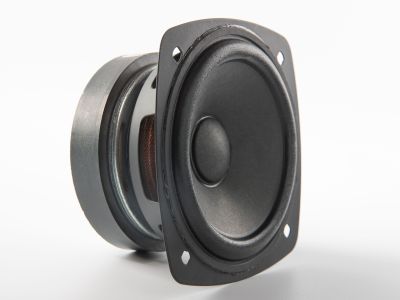
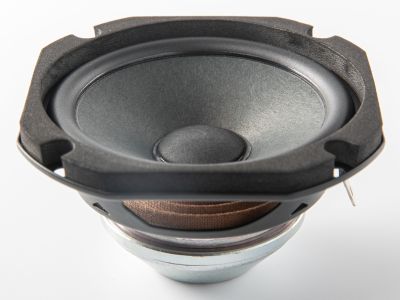
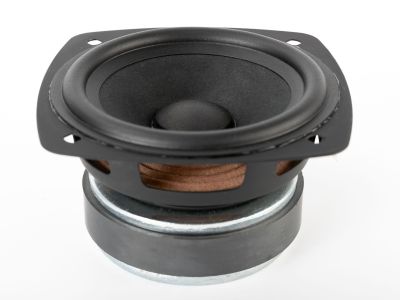
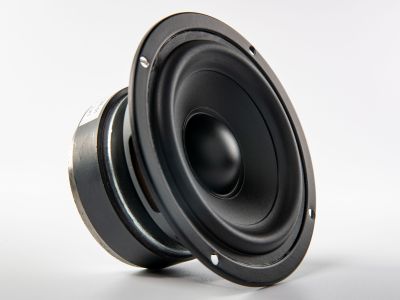
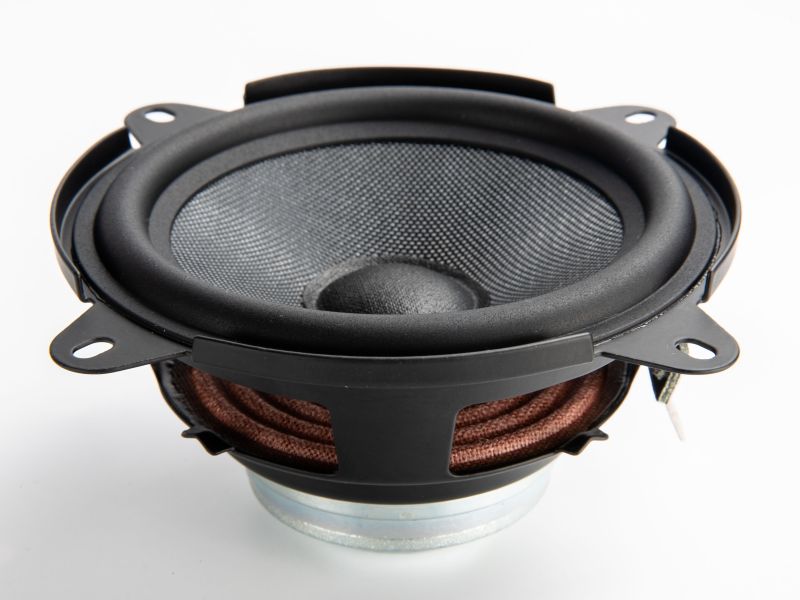
The 40NFR is a very high efficiency, (86dB 1watt / 1 meter) 4-inch full range speaker with linear frequency response characteristics and high power handling capability while generating low harmonic distortion artifacts. The 40NFR uses a unique exponential cone, made off very lightweight glass-carbon fiber woven fabric, along with a NBR single roll geometry surround. The combination provides remarkable strength, high efficiency and sustained output under extreme conditions.
Magnetic circuit design
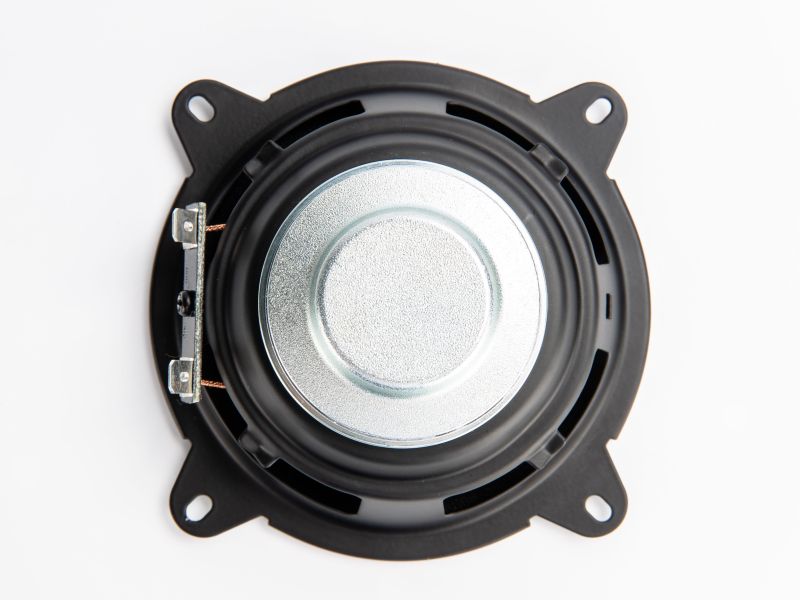
REDCATT engineers have developed neodymium based magnetic circuit, capable of delivering the highest level of performance, providing a consistent, high integrity magnetic flux gap, low distortion characteristic. The magnetic circuit design is optimized to generate the minimum amount of flux modulation, providing exceptional stability. The compact size of the magnetic circuit ensures the speaker can fit in tight space of modern audio product designs.
Magnetic circuit design
REDCATT engineers have developed neodymium based magnetic circuit, capable of delivering the highest level of performance, providing a consistent, high integrity magnetic flux gap, low distortion characteristic. The magnetic circuit design is optimized to generate the minimum amount of flux modulation, providing exceptional stability. The compact size of the magnetic circuit ensures the speaker can fit in tight space of modern audio product designs.
Specifications
General Specs
Nominal Diameter
4"
Rated Impedance
16 Ohm
Magnet
Neodymium
Basket Material
Steel
Power Handling
AES Power
25 W
Continuous Power
50 W
Peak Power
100 W
Voice Coil
Diameter
19 mm
Winding Wire
CCAW
Former
Kapton
Winding Height
4.9 mm
T/S Parameters
Resonant Frequency (Fs)
115.00 Hz
Re
12.30 \u2126
Qes
1.300
Qms
6.20
Qts
1.100
Vas
1.50 liters
Sd
50.20 cm\u00B2
Mms
4.40 grams
Rms
0.51
Cms
0.4400
Bl
5.30 T\u00B7m
Le
0.200 mH
Sensitivity
85.52 dB
Design Details
Surround Material
NBR
Cone/Dome Material
Paper CF
Spider
Nomex
T-Plate
4 mm
Xmax (peak)
0.45 mm
Xmech
4.45 mm
Overall Diameter
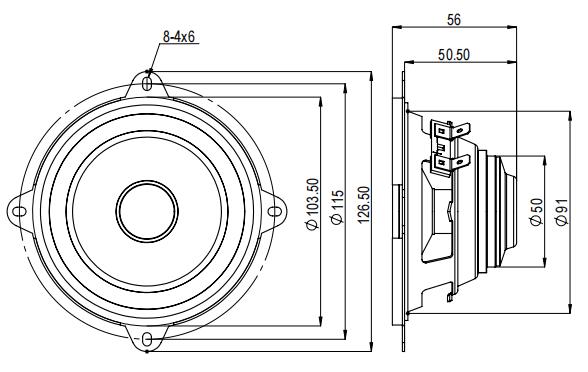
103.50 mm
Bolt Circle Diameter
115.00 mm
Baffle Cutout Dia.
91.00 mm
Mounting Holes
4
Depth (flange to rear)
50.50 mm
Net Weight
0.20 kg
Ordering Codes
Product Code
40NFRX16-223
Downloads
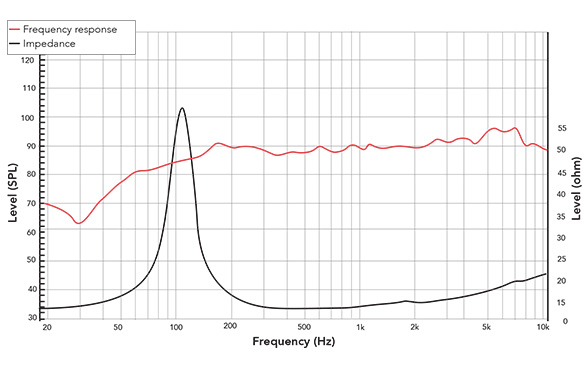
Frequency Response & Impedance
2D Drawing
Enclosure Recommendations
SPEAKER ENCLOSURE CALCULATION — 40NFRX16-223
DRIVER IDENTIFICATION
Code: 40NFRX16-223
Name: 40NFR
Category: Full-Range
Size: 4 inch
Brand: REDCATT
CONSTRUCTION
Nominal Impedance: 16 Ω (Re = 12.3 Ω DC)
AES Power: 25 W
Continuous Power: 50 W
Peak Power: 100 W
Voice Coil: 19 mm diameter, CCAW wire, Kapton former
Magnet: Neodymium (flux modulation-minimized circuit design)
Basket: Steel
Cone: Woven glass-carbon fiber fabric (GF) — exponential profile
Surround: NBR rubber, single-roll geometry
Spider: Nomex
Overall Dia.: 103.5 mm
Depth: 50.5 mm
Net Weight: 0.20 kg
NOTE ON CONE MATERIAL:
The cone is manufactured from a woven glass-carbon fiber fabric — distinct from
a paper-pulp cone with carbon fiber fill (Paper CF). The woven fabric construction
provides high stiffness-to-mass ratio and consistent mechanical properties across
the cone surface. The exponential profile further optimizes pistonic behavior
and off-axis response uniformity. Combined with the CCAW voice coil (Mms = 4.4 g),
the result is an exceptionally lightweight moving assembly contributing directly
to the high sensitivity and extended high-frequency response.
NOTE ON MAGNETIC CIRCUIT:
The neodymium circuit is engineered to minimize flux modulation — reducing the
variation in the gap flux density as the voice coil moves with signal. Reduced
flux modulation lowers position-dependent inductance variation and suppresses
even-order harmonic distortion, particularly the second harmonic. This is the
same design objective cited on the 35FRX8-406B (BL symmetry) and the 32NFRX8-463A
(neodymium ring magnet), approached here through circuit geometry optimization.
THIELE-SMALL PARAMETERS (measured, broken-in)
Fs = 115.0 Hz (free-air resonant frequency)
Re = 12.3 Ω (DC voice coil resistance)
Qes = 1.30 (electrical Q)
Qms = 6.20 (mechanical Q)
Qts = 1.10 (total Q — free-air / open-back only; see below)
Vas = 1.50 L (equivalent air volume)
Sd = 50.2 cm² (effective cone area)
Mms = 4.4 g (moving mass — low; CCAW + woven GF cone benefit)
Rms = 0.51 kg/s (mechanical resistance)
Cms = 0.44 mm/N (compliance)
Bl = 5.3 T·m (force factor)
Le = 0.20 mH (voice coil inductance)
Xmax = 0.45 mm (one-way linear excursion)
Xmech= 4.45 mm (one-way mechanical limit)
Xprot= 5.8 mm (one-way protection limit)
SENSITIVITY
Datasheet Sensitivity: 85.52 dB (2.83V/1m, per CSV Sensitivity field)
1W/1m reference (Lm): 84.39 dB (per CSV Lm field — used for Max SPL calculations)
NOTE: For a 16 Ω driver, the expected relationship is Lm (1W/1m) > Sensitivity
(2.83V/1m) by approximately 3.0 dB (since 2.83V delivers ~0.5W into 16 Ω).
The CSV values show the opposite relationship (Sensitivity > Lm by 1.1 dB),
indicating a data inconsistency for this driver. Lm = 84.39 dB is used as the
1W/1m reference throughout. The manufacturer's design notes quote 86 dB at
1W/1m — approximately 1.6 dB above the CSV Lm field.
DERIVED PARAMETERS
Volume displacement: Vd = Sd × Xmax = 50.2 cm² × 0.045 cm = 2.26 cm³
Inductance rolloff: f_Le = Re / (2π × Le) = 12.3 / (2π × 0.00020) = 9,785 Hz
Cone radius: r_cone = √(Sd/π) = 4.00 cm
Cone beaming onset: f_beam = c / (π × r_cone) = 34400 / (π × 4.00) = 2,738 Hz
Max SPL (AES, 25W): 1W/1m + 10×log10(25) = 84.39 + 14.0 = 98.4 dB at 1 m
Zobel network: Rz = 12.3 Ω; Cz = Le / Re² = 1.3 μF (series, across driver)
Column array limit: f_array = c / (2 × OD) = 34400 / (2 × 10.35) = 1,661 Hz ≈ 1.66 kHz
FREE-AIR / OPEN-BACK ANALYSIS (Qts = 1.10 — the only viable installation)
With Qts = 1.10 (> 0.707), any sealed enclosure raises the system resonance
frequency above the free-air f-3dB. Free-air / open-back mounting produces the
lowest achievable bass cutoff and is the mandatory installation approach.
Free-air resonant frequency: Fs = 115 Hz
Free-air f-3dB calculation:
1/Qts² = 0.826; 2 − 0.826 = 1.174
u = (−1.174 + √(1.174² + 4)) / 2 = (−1.174 + √5.378) / 2 = (−1.174 + 2.319) / 2 = 0.573
Ω = √0.573 = 0.757
Free-air f-3dB ≈ 0.757 × 115 = 87 Hz
RESONANCE PEAK IN FREE AIR:
With Qts = 1.10 > 0.707, the free-air response exhibits a modest peak above
the passband level near resonance:
Peak frequency: Fp = 115 × √(1 − 1/(2 × 1.10²)) = 115 × 0.766 = 88 Hz
Peak magnitude: ≈ +1.8 dB above the passband reference level
This peak is mild and easily corrected with a shelving or parametric EQ notch
at 88 Hz / −1.8 dB / moderate Q in a DSP-managed system. Without correction,
the peak produces a slight bass emphasis around 88 Hz.
SEALED ENCLOSURE — NOT RECOMMENDED:
Any sealed box raises f-3dB above the free-air value of 87 Hz. For reference:
Vb = 1.5 L (= Vas): Qtc = 1.10 × √2 = 1.56 → f-3dB ≈ 113 Hz (worse)
Vb = 3.0 L: Qtc = 1.10 × √1.5 = 1.35 → f-3dB ≈ 98 Hz (worse)
No sealed alignment improves on the free-air f-3dB of 87 Hz.
Sealed mounting is not recommended for this driver.
ENCLOSURE RECOMMENDATION SUMMARY
PRIMARY (and only recommended): FREE-AIR / OPEN-BACK
f-3dB ≈ 87 Hz | ~+1.8 dB peak at ~88 Hz (EQ-correctable)
Suitable for: column speaker arrays, open-back baffle designs, panel mounting,
2-way systems with dedicated woofer handling below 100–150 Hz.
High-pass filter: 70–90 Hz subsonic filter recommended to limit excursion below
the natural rolloff. With Xmax = 0.45 mm and Vd = 2.26 cm³, bass EQ or program
content below 80 Hz at high drive levels will cause excursion toward Xmech.
CROSSOVER AND SYSTEM DESIGN NOTES
INDUCTANCE ROLLOFF (f_Le = 9,785 Hz — well above the audio band):
Le = 0.20 mH and Re = 12.3 Ω give the highest f_Le in the full-range family —
well beyond the audio band. The impedance characteristic is essentially resistive
from 20 Hz through 9 kHz, providing a flat, predictable load for passive crossover
networks and eliminating inductance-related HF rolloff within the audio passband.
This is the primary HF advantage of the 40NFRX16-223 over smaller drivers with
lower Re: the high Re "moves" the Le rolloff well beyond audibility.
CONE BEAMING (f_beam = 2,738 Hz):
The 4-inch cone begins transitioning to directional beaming above 2,738 Hz.
In 2-way designs, crossover to a tweeter should target 2,000–2,500 Hz or lower
for wide horizontal and vertical dispersion. The exponential cone profile supports
smooth pistonic response through the midrange up to this point.
COLUMN ARRAY DIRECTIVITY (f_array = 1.66 kHz for 103.5 mm OD):
In a vertical column array, coherent vertical directivity is maintained to
approximately 1.66 kHz — the lowest column array limit in the full-range family.
The 4-inch OD is the largest in the family, and this trade-off between bass
extension (87 Hz free-air) and high-frequency array coherence (1.66 kHz) is at
its most pronounced for this driver. A co-located tweeter and crossover are
mandatory for full-range column array coverage. In arrays of 2–4 drivers, the
−6 dB coherent directivity point shifts upward by roughly 3 dB per doubling of
driver count, which partially mitigates the individual driver's 1.66 kHz limit.
16Ω IMPEDANCE AND COLUMN ARRAY WIRING:
The 16 Ω nominal impedance (Re = 12.3 Ω) enables flexible parallel wiring
in multi-driver column arrays, consistent with the 21NFRX16-393D (2", 16Ω):
2× 16 Ω in parallel = 8 Ω (standard amplifier load)
4× 16 Ω in parallel = 4 Ω (standard column array to single amplifier channel)
The higher Re also results in lower voice coil current at a given power, which
reduces thermal stress in long column wiring runs.
EXCURSION MANAGEMENT:
Xmax = 0.45 mm is the smallest in the 4-inch / 3.5-inch driver group. With
Vd = 2.26 cm³, bass boost below Fs must be applied conservatively. A mandatory
high-pass filter at 70–90 Hz is strongly recommended, and excursion limiting
(or brick-wall HPF) at 50 Hz protects against mechanical over-excursion during
low-frequency transients.
ZOBEL NETWORK:
A Zobel network (12.3 Ω + 1.3 μF in series, placed across driver terminals) is
recommended for passive crossover designs to flatten the rising impedance from Le.
Note the unusually low capacitance (1.3 μF) due to the high Re²; standard
capacitor values of 1.2–1.5 μF are appropriate.
FULL-RANGE FAMILY COMPARISON (10 drivers)
Code Size Ω W AES Qts Motor Fs Enclosure −3dB 1W/1m MaxSPL OD f_array
20NFRX4-345A 2" 4 10 0.52 Neo 185 Free-air / open-back 272 Hz 79.6 89.6 48 mm 3.58 kHz
21NFRX16-393D 2" 16 10 0.68 Neo 157 Free-air / open-back 164 Hz 85.8 95.8 57 mm 3.00 kHz
22NFRX8-462A 2" 8 20 0.85 Neo 255 Free-air / open-back 219 Hz 83.5 96.5 61 mm 2.84 kHz
25NFRX8-279 2.5" 8 20 0.71 Neo ring 123 Free-air / open-back 123 Hz 82.3 95.4 65 mm 2.65 kHz
30FFX8-264B 3" 8 20 0.78 Ferrite 119 Free-air / open-back 109 Hz 83.6 96.6 79 mm 2.18 kHz
31NFRX8-229 3" 8 30 0.88 Neo 115 Free-air / open-back 97 Hz 83.5 98.3 79 mm 2.18 kHz
32NFRX8-463A 3" 4† 30 0.32 Neo ring 118 Vented (75–115 Hz) 75 Hz 89.4 104.1 83 mm 2.07 kHz
35FRX4-155 3.5" 4 25 0.34 Ferrite 67 Vented (70–80 Hz) 70 Hz 83.1 97.1 93 mm 1.85 kHz
35FRX8-406B 3.5" 8 20 0.63 Ferrite 128 Sealed / open-back 148 Hz 87.6 100.6 93 mm 1.85 kHz
40NFRX16-223 4" 16 25 1.10 Neo 115 Free-air / open-back 87 Hz 84.4 98.4 104 mm 1.66 kHz
† Re = 5.5 Ω
−3dB: free-air for free-air/open-back drivers; Fb range for vented; Qtc=0.85 for 35FRX8-406B.
40NFRX16-223 free-air response includes a ~+1.8 dB peak at ~88 Hz; see notes above.
FAMILY NOTES:
• 40NFRX16-223 is the only 4-inch driver in the family and has the lowest free-air
f-3dB (87 Hz) of any free-air/open-back driver — 10 Hz lower than the 31NFRX8-229.
• The Qts = 1.10 is the highest in the family; the free-air response peak (+1.8 dB at
88 Hz) requires DSP correction for flat response but does not prevent installation.
• f_Le = 9,785 Hz is the highest in the family — the 40NFRX16-223 has the most
extended and flat HF impedance characteristic of any driver, making it the most
passive-crossover-friendly in terms of Le-related HF rolloff.
• The 103.5 mm OD gives the lowest column array coherence limit (1.66 kHz) — a
co-located tweeter is mandatory in any column array application.
• Net weight of 0.20 kg is by far the lightest in the family; the neodymium circuit
is extremely compact relative to the driver's acoustic output.
• Both 16 Ω drivers in the family (21NFRX16-393D and 40NFRX16-223) enable 4× parallel
column array wiring to a standard 4 Ω amplifier channel.
• Choose 40NFRX16-223 where: maximum bass extension from a free-air 4-inch driver is
required (87 Hz −3dB); 16 Ω column array wiring is preferred; lightweight neodymium
construction with woven GF cone is a design priority; flat HF impedance for passive
crossover design is valued.
• Choose 31NFRX8-229 (8Ω, Qts=0.88) where: 97 Hz free-air f-3dB is sufficient;
8 Ω is required; higher power handling (30W AES) is needed; aluminum cone.
SUMMARY
The 40NFRX16-223 is a 4-inch full-range driver featuring a neodymium magnetic circuit
optimized for minimum flux modulation, a steel basket, woven glass-carbon fiber fabric
cone with exponential profile, NBR single-roll surround, Nomex spider, and a 19mm CCAW
voice coil wound on a Kapton former. The woven glass-carbon fiber cone combines high
stiffness with low mass, contributing to the low Mms of 4.4 g and supporting extended
high-frequency response. The neodymium circuit design targets minimum gap flux modulation,
reducing position-dependent inductance variation and even-order harmonic distortion across
the excursion range. Net weight is 0.20 kg — the lightest driver in the full-range family.
The 40NFRX16-223 is the sole 4-inch driver in the lineup, offered in 16 Ω nominal
impedance with the same form factor available in 4, 8, and 16 Ω versions per application.
Fs = 115 Hz, Qes = 1.30, Qms = 6.20, Qts = 1.10 — a highly compliant suspension design
suited to free-air and open-back installations, where the driver's natural motor damping
provides the lowest achievable bass extension; any sealed enclosure raises the system
resonance above the free-air f-3dB, making sealed mounting counter-productive for this
driver. Vas = 1.50 L, Sd = 50.2 cm², Xmax = 0.45 mm (one-way), Vd = 2.26 cm³. The
free-air f-3dB is approximately 87 Hz — the lowest of any free-air driver in the family.
The free-air response includes a modest resonance peak of approximately +1.8 dB at ~88 Hz
due to Qts = 1.10 > 0.707; DSP correction with a narrow parametric notch at 88 Hz removes
this before the driver reaches its flat passband. Sensitivity is 84.39 dB at 1W/1m (Lm),
with a maximum SPL of 98.4 dB at 1 metre (25W AES). The voice coil inductance Le = 0.20 mH
gives an inductance rolloff onset of 9,785 Hz — the highest in the full-range family and
well above the audio band — providing an essentially resistive impedance from 20 Hz to
9 kHz, which is the most passive-crossover-friendly characteristic in the lineup. Cone
beaming onset at 2,738 Hz defines the upper dispersion limit. Zobel network: 12.3 Ω +
1.3 μF in series across driver terminals.
Enclosure alignment:
• Free-air / open-back (only recommended installation):
f-3dB ≈ 87 Hz; ~+1.8 dB peak at ~88 Hz (DSP-correctable)
High-pass filter at 70–90 Hz recommended in all installations
Sealed enclosures raise f-3dB above 87 Hz and are not recommended
In column array applications, the 103.5 mm driver OD limits coherent vertical directivity
to approximately 1.66 kHz — the lowest limit in the full-range family. A co-located tweeter
with crossover at 1.5–2.0 kHz is mandatory for full-range column array coverage. The 16 Ω
nominal impedance enables flexible array wiring: four drivers in parallel produce a 4 Ω
load on a standard amplifier channel, consistent with the 21NFRX16-393D wiring approach.
Excursion management is critical: Xmax = 0.45 mm limits bass equalization headroom;
a subsonic high-pass filter at 70–90 Hz and excursion limiter at 50 Hz are recommended
to prevent mechanical over-excursion during low-frequency program content.
The 40NFRX16-223 is suited for column speaker systems requiring the deepest free-air bass
extension (87 Hz) from a full-range driver with 16 Ω parallel array wiring; 2-way
desktop, bookshelf, and surface-mount loudspeakers where the woven GF cone and neodymium
motor deliver low-distortion midrange and extended HF in an open-back or minimal-enclosure
format; hi-fi column and panel-mount designs crossed above 100 Hz to a woofer or subwoofer
with DSP correction of the 88 Hz resonance peak; and applications requiring the most
passive-crossover-friendly HF impedance characteristic in the full-range family (f_Le =
9,785 Hz), where Le-related HF droop is absent across the entire audio band.
Frequently Asked Questions
- - Full-range FREQUENCY RESPONSE
- - Unique cone material
- - For column systems, desktop high performance 2 way or one-way speakers, hi-fi applications
SPEAKER ENCLOSURE CALCULATION — 40NFRX16-223 DRIVER IDENTIFICATION Code: 40NFRX16-223 Name: 40NFR Category: Full-Range Size: 4 inch Brand: REDCATT CONSTRUCTION Nominal Impedance: 16 Ω (Re = 12.3 Ω DC) AES Power: 25 W Continuous Power: 50 W Peak Power: 100 W Voice Coil: 19 mm diameter, CCAW wire, Kapton former Magnet: Neodymium (flux modulation-minimized circuit design) Basket: Steel Cone: Woven glass-carbon fiber fabric (GF) — exponential profile Surround: NBR rubber, single-roll geometry Spider: Nomex Overall Dia.: 103.5 mm Depth: 50.5 mm Net Weight: 0.20 kg NOTE ON CONE MATERIAL: The cone is manufactured from a woven glass-carbon fiber fabric — distinct from a paper-pulp cone with carbon fiber fill (Paper CF). The woven fabric construction provides high stiffness-to-mass ratio and consistent mechanical properties across the cone surface. The exponential profile further optimizes pistonic behavior and off-axis response uniformity. Combined with the CCAW voice coil (Mms = 4.4 g), the result is an exceptionally lightweight moving assembly contributing directly to the high sensitivity and extended high-frequency response. NOTE ON MAGNETIC CIRCUIT: The neodymium circuit is engineered to minimize flux modulation — reducing the variation in the gap flux density as t...
AES Power: 25 W,
Continuous: 50 W,
Peak: 100 W.
Sensitivity: 85.52 dB (1W/1m).