Glass Diaphragm Compression Drivers
A glass compression driver uses a dome formed from chemically strengthened glass instead of titanium, aluminium or a polymer film. The glass diaphragm transmits sound faster than titanium, weighs barely half as much, and damps its own resonances 7.5 times better — so the glass dome reaches 20 kHz without the metallic breakup ringing of a metal dome. This page explains the material, the measurements, and the REDCATT drivers built around it.
What is a glass dome diaphragm?
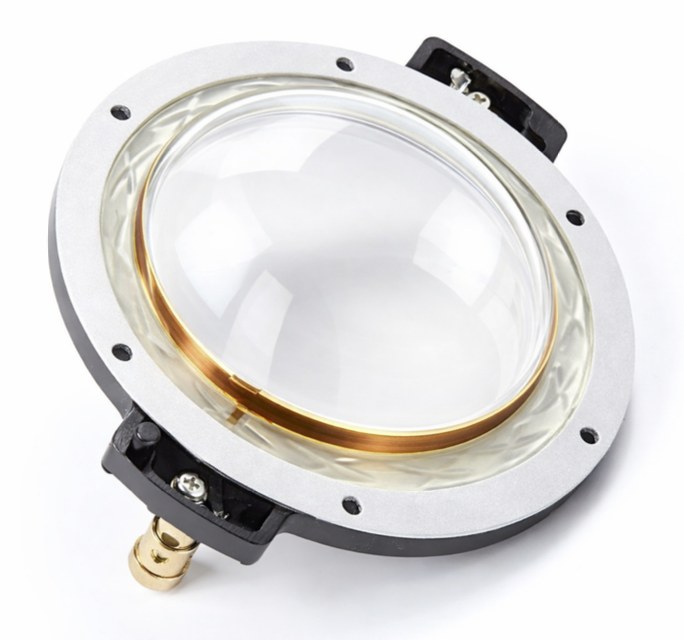
A glass dome diaphragm is the moving element of a high-frequency driver formed from a thin sheet of amorphous, chemically strengthened glass. In a compression driver the dome sits on a voice coil, compresses air through a phase plug into a horn, and must stay rigid to 20 kHz while surviving professional power levels. Glass domes first appeared in earphones and hi-fi tweeters; REDCATT was the first to engineer the material, the forming process and the assembly technology that make a glass dome work inside a 1.4-inch professional compression driver, and the first to bring one to market.
The glass is chemically strengthened by ion exchange: sodium ions in the surface are replaced with larger potassium ions, placing the surface under permanent compression and raising strength by a factor of five or more over ordinary glass. Unlike paper or polymer diaphragms, glass is immune to humidity, temperature cycling and ageing — its properties on day one and day ten thousand are the same.
The diaphragm in REDCATT's glass compression drivers is not a sourced component. The glass composition, the process that forms it into a dome, and the technology that assembles dome, surround and voice coil into a driver are REDCATT's own in-house development, currently patent pending.
Why the diaphragm decides the sound
A compression driver is conceptually simple: a dome diaphragm driven by a voice coil compresses air through a phase plug into a horn. Below a certain frequency the dome moves as a rigid piston and its output follows the electrical signal faithfully. Above that frequency the dome begins to flex — it breaks up into regions vibrating out of phase with each other. Breakup adds resonant peaks, response ripple and harmonic distortion exactly where the ear is most sensitive.
Two material properties govern this behaviour. The speed of sound in the material, roughly √(E/ρ) where E is stiffness and ρ density, sets how high in frequency pistonic motion holds — faster is better. The internal damping factor (η) sets what happens when breakup eventually occurs: a poorly damped material rings like a bell at its breakup frequency, a well damped one dissipates the resonance as heat. Density matters too, since a lighter dome means less moving mass and higher sensitivity. Diaphragm selection is the art of balancing all three.
Glass vs titanium vs beryllium: the materials compared
The ideal diaphragm would be perfectly rigid, vanishingly light and able to absorb its own resonances. No conventional material offers all three. Titanium and aluminium are stiff but ring; polymers are well damped but soft; beryllium approaches the ideal but is hazardous to process and expensive. Glass occupies a position no other practical material does.
| Material | Density (g/cm³) | Young's modulus (GPa) | Sound velocity (m/s) | Damping factor (η) |
|---|---|---|---|---|
| Beryllium | 1.85 | 287 | 12,500 | 0.005 |
| Glass (chemically strengthened) | 2.4 | 70–80 | 5,800 | 0.015 |
| Aluminium | 2.7 | 70 | 5,400 | 0.002 |
| Titanium | 4.5 | 110–116 | 5,200 | 0.002 |
| Paper | ~1.0 | 1.9 | 3,200 | 0.040 |
Sound velocity and damping factor as published by Nippon Electric Glass [1]; modulus and density ranges per BDNC [2].
Titanium
The industry workhorse for decades: durable, formable and tolerant of high temperatures. But it is the densest material in the table and one of the worst damped (η = 0.002). Its breakup typically falls within or just above the audible band, and because the resonance is undamped it radiates — the familiar dry, metallic top octave of conventional compression drivers, increasingly audible at high drive levels [3].
Aluminium
Lighter and similarly stiff, but it shares the same negligible internal damping, and its lower strength limits power handling in compression driver applications.
Beryllium
The benchmark on paper: a sound velocity of 12,500 m/s pushes breakup beyond 40 kHz. In practice it carries serious liabilities — beryllium dust is highly toxic (inhalation can cause berylliosis, a chronic lung disease), processing is restricted to specialised facilities, and finished diaphragms cost an order of magnitude more than titanium [2][3].
Polymers and coated fabrics
Damp well but are too soft to maintain pistonic motion across a compression driver's bandwidth, and they degrade with heat, humidity and time.
The case for a glass diaphragm
Glass — amorphous SiO₂ — transmits sound at roughly 5,800 m/s, faster than titanium, so a glass dome holds pistonic motion at least as far up the band as the industry-standard metal. At 2.4 g/cm³ it is barely half the density of titanium, reducing moving mass and supporting high sensitivity. And critically, its damping factor of 0.015 is 7.5 times that of titanium or aluminium [1]: when the dome does approach breakup, the resonance is absorbed inside the material instead of being radiated as ringing.
The amorphous structure is the key. Metals are crystalline; vibration energy travels along the lattice with very little loss, which is why a struck metal dome rings. Glass has no lattice — its disordered molecular network scatters and dissipates vibrational energy internally. The audible result is a top end with metal-like extension and detail, but without the metallic signature.
Glass dome, in four lines
- Higher sound velocity than titanium — pistonic motion maintained across the working band
- 7.5× the internal damping of titanium or aluminium — no audible breakup ringing
- Half the density of titanium — lower moving mass, high sensitivity
- Chemically strengthened, non-toxic and dimensionally stable for the life of the product
Glass in practice: the REDCATT 202N-GL
Theory is only as good as its execution. The REDCATT 202N-GL was the first compression driver to reach production with a glass diaphragm. Glass domes are no longer exclusive to REDCATT — a small number of other manufacturers have since followed, which we take as confirmation of the material's merit. What sets the 202N-GL apart is that its diaphragm is REDCATT's own development from raw material to finished driver: a glass composition formulated for acoustic duty, the production technology to form that glass into a finished dome, and the manufacturing technology to assemble dome, surround and voice coil into a driver that withstands professional power levels. Each layer represents years of in-house development, and the technology is currently patent pending.
The glass dome is paired with a 3-inch copper-clad aluminium ribbon voice coil on a kapton former, driven by a neodymium motor, and suspended on a PEI surround that mechanically decouples and damps the dome's edge. The complete driver weighs 1.9 kg and is just 58 mm deep — suited to weight-sensitive arrays and compact two-way systems.
| Parameter | 202N-GL |
|---|---|
| Diaphragm | Precision-formed glass dome |
| Exit / throat | 35 mm (1.4 in) |
| Voice coil | 3 in (76 mm), copper-clad aluminium ribbon on kapton former |
| Magnet | Neodymium |
| Nominal impedance / Re | 8 Ω / 5.9 Ω |
| Power handling | 70 W AES, 140 W continuous, 280 W peak |
| Sensitivity | 109.5 dB (1 W / 1 m) |
| Free-air resonance (Fs) | 710 Hz |
| Surround | PEI |
| Dimensions / weight | 112 mm dia. × 58 mm deep, 1.9 kg net |
Full engineering data
Complete specifications, frequency response and impedance plots, datasheet PDF, 2D drawing and 3D STEP model on the product page.
202N-GL product page →In system design terms
The 202N-GL behaves conventionally: recommended crossover 1.2–1.5 kHz or higher (12 dB/octave minimum, 24 dB/octave preferred), standard 1.4-inch horns, and DSP protection as with any professional HF driver. The difference is what arrives at the listener: an effortless, low-distortion top end that needs no corrective equalisation for breakup artefacts.
Measured performance of the glass compression driver
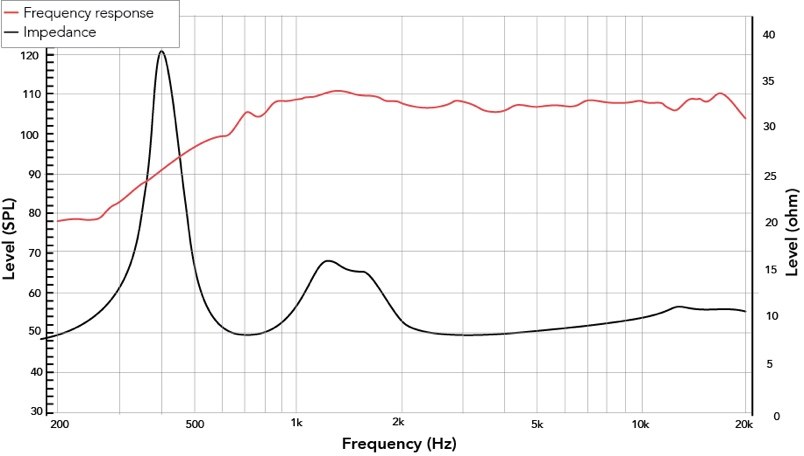
Klippel measurements of the 202N-GL fundamental response show output rising through the 500 Hz region (below the intended passband, around the 710 Hz free-air resonance) onto a plateau of approximately 108–110 dB that extends from roughly 1 kHz to 20 kHz. The plateau is free of the isolated high-Q breakup peak that typically appears in the top octave of titanium-dome drivers; output is fully maintained at 20 kHz. This is the measured signature of a stiff, well-damped diaphragm — and precisely what the material data predicts.
Time-domain evidence: cumulative spectral decay
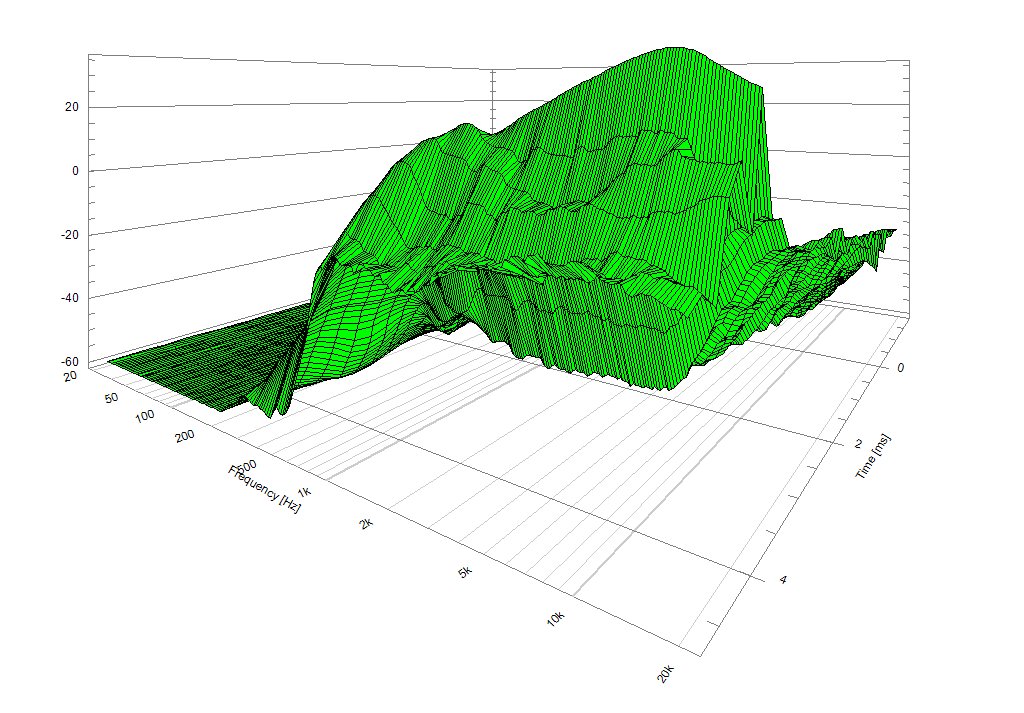
Frequency response shows what a driver does; cumulative spectral decay (CSD) shows what it keeps doing after the signal stops. A CSD waterfall plots the decay of stored energy across frequency and time — resonances appear as ridges that persist along the time axis, and it is precisely this lingering energy the ear hears as a material's "signature".
The CSD of the 202N-GL, displayed over a full 80 dB dynamic range from 20 Hz to 20 kHz, shows stored energy dissipating rapidly and uniformly across the working band. There are no isolated, persistent ridges in the top octaves — the pattern that betrays undamped diaphragm modes ringing after the stimulus ends. Decay behaviour is consistent across the passband, which is the time-domain counterpart of the smooth fundamental response.
This is what the material data predicts. Even beryllium — the most highly regarded metal diaphragm material — retains the damping of a metal: its loss factor of η = 0.005 is one third that of glass (η = 0.015) [1]. Whatever energy enters a metal dome's resonant modes must ring before it dissipates; in glass, it is absorbed within the material almost immediately. Glass delivers this damping advantage without beryllium's toxicity, handling restrictions or cost.
Which REDCATT drivers use a glass diaphragm?
One catalog model currently uses REDCATT's glass dome diaphragm. Further glass-diaphragm compression drivers are in development; every model carries full engineering data on its product page.
A glass dome is also an option for OEM and ODM programmes: exit, coil, impedance and motor variations around the glass diaphragm are handled through the OEM/ODM development process.
Glass diaphragm questions, answered
Does REDCATT make glass diaphragm compression drivers?
Yes. The 202N-GL – the first glass-diaphragm compression driver to reach production – is a 1.4-inch exit, 3-inch voice coil neodymium compression driver with a dome formed from chemically strengthened glass; further glass-diaphragm models are in development. The glass composition, the forming process and the assembly technology are REDCATT's own in-house development (patent pending) – the diaphragm is not a sourced component. The material, the measurements and the design reasoning are explained on the glass diaphragm technology page.
How does a glass diaphragm compare with titanium or beryllium?
Glass transmits sound faster than titanium (about 5,800 m/s vs 5,200 m/s), has roughly half the density (2.4 vs 4.5 g/cm³) and an internal damping factor about 7.5 times higher (0.015 vs 0.002), so a glass dome holds pistonic motion as far up the band as titanium but absorbs its breakup resonance instead of ringing. Beryllium is stiffer still (12,500 m/s) but keeps a metal's low damping (0.005), is toxic to process and costs an order of magnitude more. The measured result on the 202N-GL is a smooth response from about 1 kHz to 20 kHz with no isolated breakup peak and a clean cumulative spectral decay. The full comparison table and Klippel plots are on the glass diaphragm technology page.
Is a glass dome diaphragm fragile?
No. The dome is chemically strengthened by ion exchange: sodium ions in the surface are replaced by larger potassium ions, which puts the surface under permanent compression and raises strength by a factor of five or more over ordinary glass. The 202N-GL is rated 70 W AES (140 W continuous, 280 W peak) like a conventional 3-inch coil driver, and unlike paper or polymer diaphragms the glass does not change with humidity, temperature cycling or age. Normal compression-driver handling and DSP protection apply.
More commercial and technical answers in the FAQ.
Hear the glass dome for yourself
Sample drivers are available for evaluation. Ask for a 202N-GL sample, the datasheet, or a glass-diaphragm variant for your own programme — our engineers answer technical questions directly.
References
- [1] Nippon Electric Glass, "Ultra-thin Glass Diaphragms, the Key to Next-Generation Quality Sound Speakers".
- [2] W. K. Chu, BDNC (Holding) Ltd., "The use of Novel Engineering glass as speaker diaphragms: advantages, opportunities, and design hints" (2018).
- [3] audioXpress, "Comparative Studies on the Behavior of Beryllium, Titanium, and CN Fiber Hybrid Dome in the Last Octave".
- [4] REDCATT, Klippel measurement of the 202N-GL: fundamental and harmonic distortion components, cumulative spectral decay (internal data, 2026).
Adapted from the REDCATT white paper "Sound Through Glass" (June 2026, revised September 2026).